
At A1 Screening, we have seen how the "parachute effect" can dismantle a pool cage in seconds. Most homeowners view their screens as simple bug barriers, but in a Southwest Florida hurricane, they are the primary defense mechanism against structural uplift. Maintaining your screen mesh is not just about aesthetics—it is a critical structural mitigation that allows your cage to breathe and survive. Beyond storm safety, your enclosure serves as the essential daily barrier against Southwest Florida's pests and a vital safety zone for your family.
Prerequisites: A sturdy ladder, heavy-duty zip ties, stainless steel self-tapping screws, a cordless drill, and approximately 3–4 hours of lead time before wind speeds reach 39 mph.
How do I perform a pre-storm structural audit?
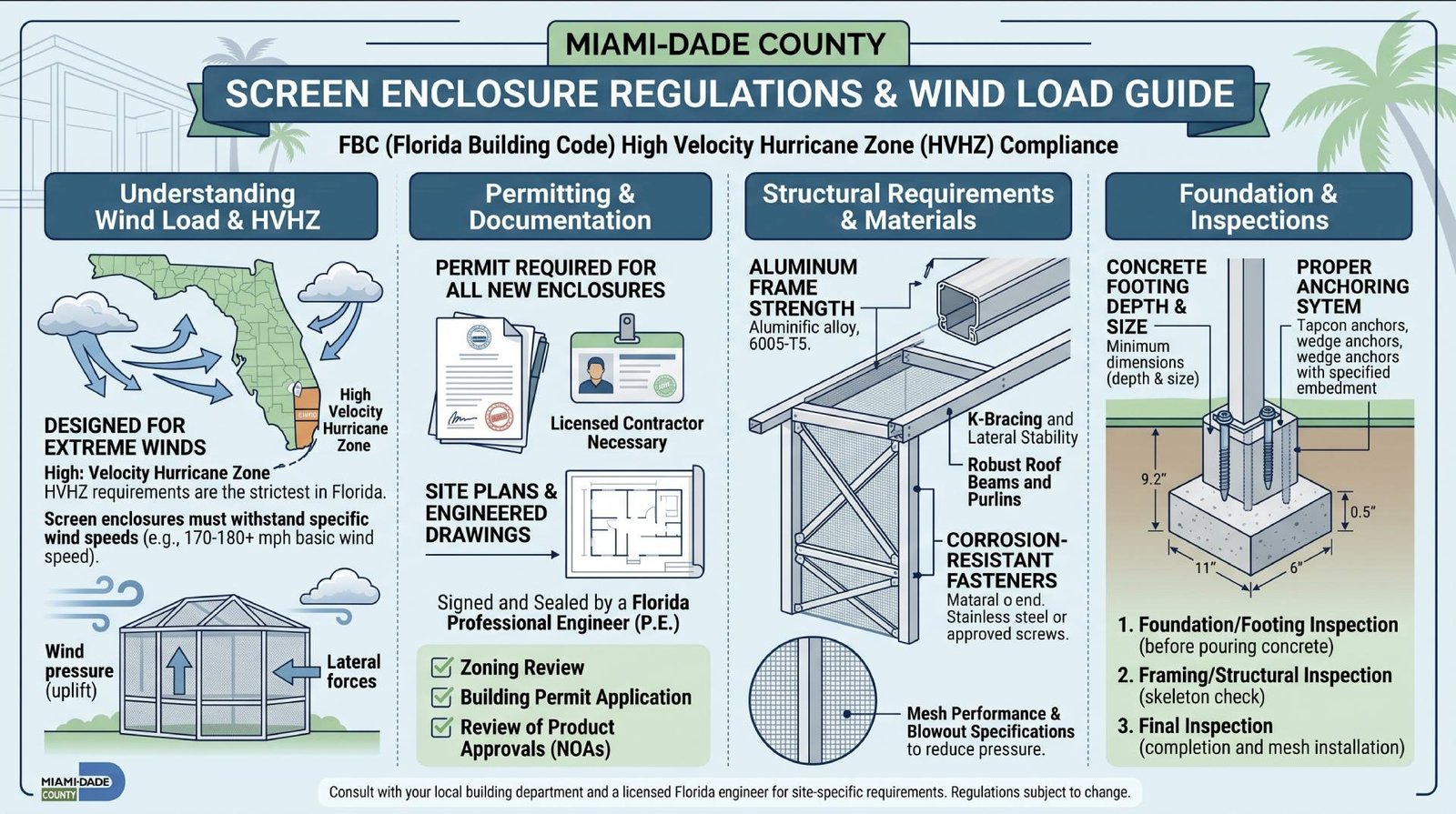
The first step in hurricane readiness is identifying the weak points in your enclosure’s "armor." You must verify that the aluminum frame is actually anchored to the concrete and that the screws holding the joints together haven't been hollowed out by saltwater corrosion. In Naples, properties within three miles of the Gulf are at high risk for galvanic corrosion, where salt air triggers a chemical reaction between different metals, causing standard steel screws to fail silently inside the aluminum joints.
Walk the perimeter and check the base of each vertical post. You should see 3/8-inch stainless steel Tapcon anchors securing the frame to the deck. If these anchors are loose or if the concrete is cracked around them, the cage is at risk of "uplift," where wind gets under the roof and rips the entire structure out of the ground. Next, use a ladder to inspect the roof-to-wall connections. These joints bear the brunt of the lateral wind load and must be tight and free of visible orange rust.

Success Check: You should have a list of any loose fasteners or missing anchors that require immediate replacement before the storm's arrival.
Step 2: How do I clear and secure the lanai interior?
Before the wind begins to pick up, you must transform your lanai from a living space into a secure zone. Any item not bolted down—furniture, potted plants, grills, and pool toys—becomes a high-speed projectile that can shred your screens from the inside or, worse, shatter your home’s sliding glass doors. In Naples, wind-driven debris is often the secondary cause of total enclosure failure; when a screen is punctured by a flying chair, it creates an opening that allows wind to "catch" the rest of the structure like a sail.
Move all lightweight furniture inside the house or the garage. If you have heavy items that cannot be moved, such as a large granite-top table, secure them with heavy-duty ratcheting tie-downs to the enclosure’s structural posts or weighted anchors. Do not place furniture in the pool unless it is made entirely of plastic or high-quality aluminum; metal furniture can cause galvanic corrosion to the pool finish or tear the liner. Additionally, clear your gutters of leaves and pine needles to prevent water from backing up and adding thousands of pounds of unnecessary weight to the enclosure's "super gutter" system.
Success Check: Your lanai floor should be completely bare, with no loose items capable of being lifted by 40+ mph wind gusts.
Step 3: How do I manage airflow to prevent the "Parachute Effect"?
The most counterintuitive part of hurricane preparation is that a "solid" pool cage is a dangerous pool cage. When hurricane-force winds hit a fully screened enclosure, the mesh acts as a solid wall, creating a massive pressure differential. This is known as the "parachute effect": windward pressure pushes against the front, while leeward suction pulls from the back, and vertical uplift pulls the roof upward. By creating intentional airflow paths, you can reduce structural stress by over 40%.
The Florida Building Code (Section 2002.7) allows for the removal of specific panels to reduce wind load. At A1 Screening, we recommend removing at least one screen door entirely by popping the hinge pins. This creates a large, unobstructed exit for the wind. If the storm is predicted to exceed Category 2 (96+ mph), you should consider "venting" the enclosure by cutting the screens in the center of the largest panels on opposite sides of the structure. Use a utility knife to make a vertical slit; it is far cheaper to replace a few mesh panels than to rebuild a collapsed $30,000 aluminum frame.
Success Check: You should have at least two large, open passageways (such as removed doors or cut panels) on opposite sides of the enclosure to allow for cross-ventilation.
What are the lifestyle benefits of a well-maintained pool cage?
Beyond hurricane protection, a screen enclosure is the primary reason Florida outdoor living is possible. In Naples, where the humidity and proximity to the Everglades create a haven for biting insects, a well-maintained cage provides a 24/7 barrier against pests while keeping family members safe.
Bug and pest exclusion is the most immediate daily benefit. Southwest Florida is home to aggressive mosquitoes and nearly invisible biting midges, known locally as "No-See-Ums." A 2026 Florida screening report from Screen Armors confirms that while standard 18/14 mesh blocks mosquitoes and flies, a tighter 20/20 weave is specifically required to exclude the smallest biting pests, ensuring your lanai remains a bug-free zone.
Child and pet safety are equally essential advantages of a functional enclosure. Per Florida Building Code (Section R4501.17), screen enclosures serve as a legally compliant pool safety barrier, keeping toddlers and pets contained within a controlled area. This physical boundary provides a critical layer of protection by preventing unsupervised access to the water and deterring neighborhood wildlife from entering your deck.
Success Check: Your enclosure should be free of any holes or gaps in the spline tracks, ensuring that no pests can bypass the screen and that doors close and latch properly for child safety.
Five structural benefits of keeping your pool cage screen in good shape
While the daily comforts of pest control and safety are the most visible perks, maintaining your screen mesh is also a structural necessity for hurricane survival. A neglected cage is a liability that can lead to total frame failure. Here are the five engineering benefits of keeping your screens in top condition.
1. Improved wind pressure equalization
Healthy screen mesh manages the "parachute effect." When screens are taut, the enclosure handles wind resistance while allowing a controlled volume of air to pass. Sagging mesh flaps violently, creating erratic pressure that places higher stress on the aluminum frame. Consistent tension helps the structure respond predictably to high-velocity gusts.
2. Prevention of projectile punctures
A screen in good shape acts as a flexible shield against flying debris like palm fronds. Modern polyester-reinforced mesh has high burst strength, often deflecting debris without tearing. Brittle, UV-damaged screens shatter on impact, allowing wind and debris to enter the lanai and threaten your home's glass doors.
3. Maintenance of structural frame tension
A pool cage is a tension-based structure. The screen mesh, when properly splined into aluminum tracks, helps hold the frame in alignment and dampens wind vibrations. Missing panels cause the frame to lose this effect, leading to swaying that fatigues fasteners and corner joints.
4. Mitigation of salt-air corrosion
Screens serve as the first defense against corrosive salt mist. While porous, mesh breaks the velocity of wind-driven salt spray. This significantly extends the lifespan of interior aluminum joints compared to an exposed frame, where salt can sit directly on the fasteners and trigger rapid oxidation.
5. Preservation of property value and insurance compliance
A well-maintained pool cage adds between $15,000 and $40,000 to a Naples home's value. In a hurricane claim, adjusters look for "prudent maintenance." Screens that were clearly rotted before a storm may lead to claims being denied as wear and tear rather than storm damage. Keeping your cage in good shape ensures you are legally and financially prepared for a disaster.
1Should I cut my screens for every tropical storm?
No. You should only consider venting or cutting panels if wind speeds are forecast to exceed 75 mph (Category 1 hurricane strength). For lower wind speeds, removing screen doors is usually sufficient to manage pressure.
2How can I tell if my fasteners are structurally failing?
Look for 'orange bleed' staining on the aluminum around the screw head. If the head looks hollowed out or if you can turn it easily with a screwdriver, galvanic corrosion has likely compromised the fastener's grip.
3Is it safe to put my patio furniture in the pool?
We do not recommend this. While it prevents the furniture from flying, metal items can cause permanent staining or galvanic corrosion to your pool finish, and heavy items can damage the pool liner or tiles.
No comments yet. Be the first to share your thoughts!