AI has shifted from a "nice-to-have" experimental tool to the central logic of the world’s largest advertising ecosystems. This guide outlines how 2024 trends are maturing into the 2026 landscape, where 63% of marketers now use generative AI to power their core campaign logic. Based on current Salesforce industry projections, the next two years will see 88% of brands pivot specifically to account for AI-driven search environments like ChatGPT and Google’s Search Generative Experience.
The primary value of AI in paid media is the shift from manual hypothesis testing to real-time mechanical optimization. Where a human team might take two weeks to analyze the performance of five ad variants, AI frameworks can now detect winning creative in as little as 3 to 5 days with 95% statistical confidence. This speed allows brands to find "unicorn" ads—the top 1% of assets that drive the majority of ROI—before their competitors even finish their first A/B test.
AI Automation in the Campaign Lifecycle
AI agents now handle the repetitive, data-heavy tasks that previously consumed 70% of a performance marketer's week. This automation spans three core phases: signal processing, creative assembly, and budget fluidity. By offloading these to machine learning models, teams can focus on "Signal-to-Story" strategies — ensuring the AI has the right data to start with and the right narrative to scale.
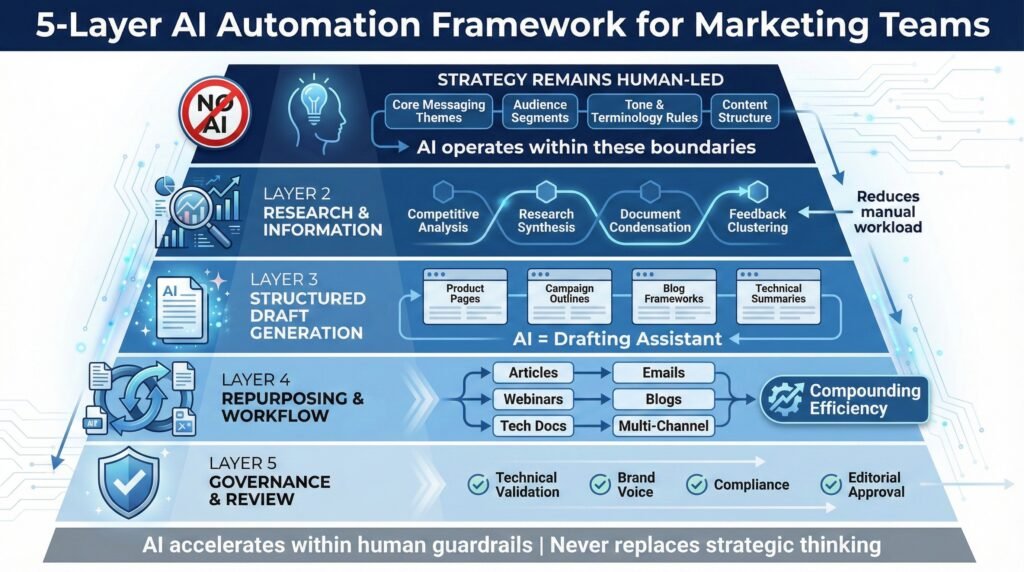
In the signal processing phase, AI systems ingest first-party data to build predictive audiences. In 2026, 84% of marketers rely on first-party data because privacy regulations have rendered third-party cookies nearly obsolete. AI bridges this gap by "modeling" lookalike audiences based on verified customer behaviors rather than broad demographic guesses.
For creative assembly, AI handles "Dynamic Creative Optimization" (DCO). It takes raw ingredients—headlines, images, and video clips—and remixes them into thousands of permutations tailored to individual users. This isn't just about changing a background color; it’s about the AI understanding that a user in Seattle responds better to "rain-ready gear" imagery while a user in Miami sees "lightweight breathable" messaging for the same product.
Google Performance Max vs. Meta Advantage+
Choosing between the two giants of AI advertising depends on whether your goal is to capture existing demand or generate new interest. In 2026, Google Performance Max (PMax) is the dominant tool for capturing search intent across YouTube, Search, and Display, while Meta Advantage+ is designed to fuel discovery and demand on Facebook and Instagram.
Feature | Google Performance Max | Meta Advantage+ Shopping |
|---|---|---|
Primary Strength | Captures active intent through keyword and search behavior. | Generates new demand through high-impact creative storytelling. |
ROAS Performance | Typically higher, with median benchmarks ranging from 2.57x to 4.6x. | Optimized for lower CPA through rapid creative iteration. |
Targeting Logic | Relies on "Audience Signals" to guide machine learning. | Often functions as a "black box" where specific targeting is removed. |
Ideal Budget | Requires €1,200–2,400 monthly minimum to feed the algorithm enough data. | Highly scalable once a "unicorn" creative is identified. |
Google PMax is effectively an "all-in-one" campaign type. It requires marketers to provide high-quality assets and deep conversion data; the AI then determines which "surface" (e.g., a Gmail ad versus a YouTube pre-roll) is most likely to result in a sale. Conversely, Meta Advantage+ focuses heavily on the "Creative as Targeting" philosophy. Because the AI is so good at identifying who interacts with what imagery, many marketers now find that removing manual audience filters and letting Meta’s AI find the audience produces a significantly lower CPA.
Solving the "Creative Wall" with Generative AI
The biggest bottleneck in modern advertising isn't the budget—it's the volume of creative required to keep up with AI optimization. Most traditional creative testing fails at the "asset supply layer" because brands simply cannot afford to produce the 20 to 30 variants required for a statistically significant AI test cycle. Generative AI has changed the economics of this production, allowing marketers to scale creative production frequencies that were previously impossible.
Using AI for creative isn't just about "generating an image." High-performing teams use a hybrid approach:
Core Human Concepting: Humans define the brand’s "Big Idea" and emotional hook.
AI Multivariate Variation: AI takes those ideas and generates hundreds of layout, color, and copy variations.
Automated Fatigue Detection: AI monitors frequency and performance decay. When an ad starts to "fatigue" (the CPA rises as everyone sees the ad too many times), the system automatically swaps in a fresh variant from the library.
This "always-on" testing framework reduces the risk of expensive campaign flops. Instead of betting $50,000 on one high-production video, marketers spend $5,000 on 50 AI-assisted variations to see which one resonates, then put the remaining $45,000 behind the proven winner.
Brand Safety Risks in AI-Driven Workflows
The speed of AI comes with the risk of "hallucinations" and placement errors. A 2026 report indicates that 83% of digital media experts view brand safety as an increasing concern as AI content volumes grow. There is a genuine danger of AI systems misrepresenting brand facts or placing ads next to toxic, synthetic content.
The risk of AI "hallucinatory" claims is particularly high for regulated industries like finance or healthcare. Even top-tier models like GPT-4o have shown hallucination rates around 1.5%, which can lead to ads promising incorrect prices or making non-compliant medical claims.
To mitigate this, marketers are adopting "Responsible AI" principles, often following the Advertising Association’s 2026 Best Practice Guide. These principles include:
Human-in-the-Loop (HITL) Reviews: Every AI-generated claim must be verified by a human expert before going live.
Negative Sentiment Exclusion: Using AI-powered sentiment tools to ensure ads don't appear alongside controversial AI-generated news or deepfaked content.
Data Unification: Closing the gap on fragmented data so the AI has a "single source of truth" for brand facts, avoiding errors rooted in outdated information.
Moving from "Optimization" to "Growth Engineering"
Marketers who see the best results in 2026—reporting 20% ROI increases and 19% cost reductions—are those who treat AI as a partner rather than a replacement. The job role is shifting from "Ad Manager" to "Growth Engineer."
In this new landscape, your job is to manage the "inputs." This means ensuring your CRM is feeding clean conversion signals back to Google and Meta. If the AI is fed "garbage" data (like low-quality leads that never buy), it will efficiently optimize for more garbage. The "Human Edge" lies in strategic data governance and the ability to weave a human story into the AI’s machine-led delivery.
As we look toward the second half of 2026, the brands that win will be those that master the balance: using AI for the mechanical "heavy lifting" while doubling down on human empathy and creative strategy at the top of the funnel.
Frequently Asked Questions
Is manual targeting still useful in 2026?
Manual targeting is increasingly used as a "guardrail" rather than a primary tactic. Most experts suggest using "Audience Signals" to point the AI in the right direction, but then giving the algorithm the freedom to expand beyond those filters to find hidden pockets of high-value users.
How much data does an AI campaign need to be effective?
Most AI systems require a "learning period" of at least 50 conversion events per week per campaign. Without this volume of data, the AI cannot accurately predict which users are most likely to convert, often leading to erratic performance and wasted spend.
Can AI replace a creative agency?
AI hasn't replaced the need for high-level strategy and art direction. Instead, it has replaced the "production" side of agency work. Agencies are now shifting to become "AI-enabled," focusing on the deep psychological hooks that make people click, while using AI to build the hundreds of assets needed to test those hooks.
What is the biggest mistake marketers make with AI ads?
The biggest mistake is treating AI as "set it and forget it." AI campaigns require constant "input monitoring." If you don't regularly refresh your creative or if your tracking pixels break, the AI will continue to spend your budget based on flawed assumptions, which can lead to rapid financial losses—a phenomenon where AI hyper-optimizes for the wrong metric or consumes daily caps on low-value traffic more quickly than a human operator often can identify.
No comments yet. Be the first to share your thoughts!