
The primary difference between customer success and sales lies in their relationship to time: sales is focused on the transactional present, while customer success is dedicated to the relational future. While sales teams are incentivized to convert prospects into paying customers through high-velocity negotiation, customer success (CS) teams are measured by their ability to ensure that the customer actually achieves the value promised during that sales cycle.
In 2026, the convergence of these two roles is accelerating. According to Forrester’s 2026 Predictions, the traditional "wall" between pre-sales and post-sales is crumbling as B2B buyers now demand continuous proof of value. It is no longer enough to "sell the dream"; the CS team must now live that dream alongside the client to secure the renewal.
What Are the Core Functional Differences?
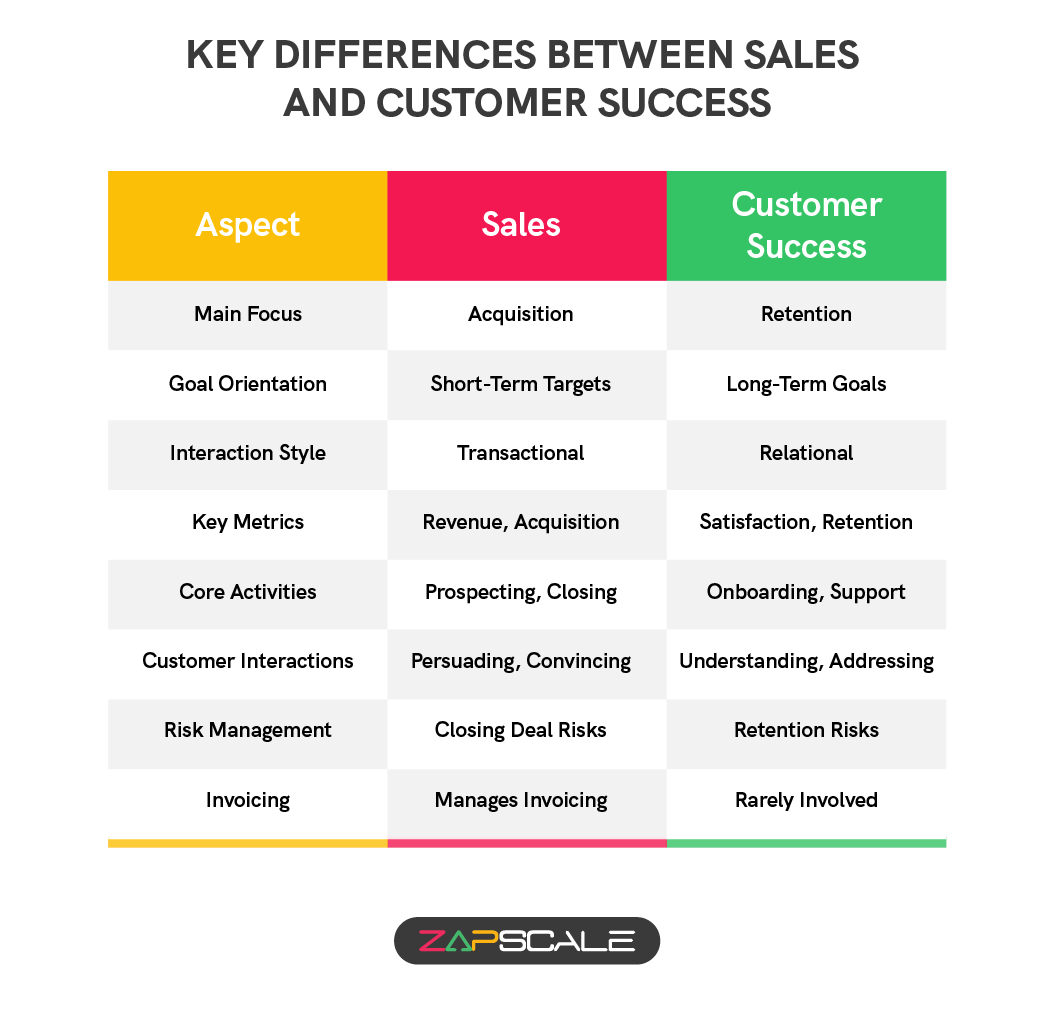
The fundamental distinction is that sales captures value, while customer success delivers value. Sales is typically a "one-to-some" or "one-to-one" sprint focused on a specific close date, whereas CS is a "one-to-many" or deeply embedded "one-to-one" marathon that starts the moment the contract is signed.
Research from Advocacy Maven highlights that CS has shifted from "churn defense" to "revenue engineering" in 2026. This means that while the functions differ in their daily tasks, they are increasingly measured by the same ultimate metric: Net Revenue Retention (NRR).
Feature | Sales (Account Executives) | Customer Success (CSMs) |
|---|---|---|
Primary Goal | Acquisition of new logos and initial contract value. | Retention, adoption, and long-term value realization. |
Duration | Short-term (typically 3–9 month sales cycles). | Long-term (continuous throughout the relationship). |
Key Metric | Annual Contract Value (ACV) and New Logos. | Net Promoter Score (NPS) and Net Revenue Retention. |
Main Interaction | Negotiating terms, pricing, and high-level fit. | Training, onboarding, and strategic optimization. |
How Do the Metrics and Incentive Structures Differ?
Sales incentives are almost exclusively tied to the immediate revenue of a signed contract. Customer Success incentives are more nuanced, often involving a mix of retention bonuses, expansion triggers, and qualitative health scores.
In 2026 benchmarks, median B2B conversion rates have stabilized at roughly 2.9%, putting immense pressure on sales to find new leads. Conversely, CS teams are dealing with an average of 13 decision-makers per enterprise account, requiring a level of multi-threaded relationship management that a typical sales cycle does not allow for. The CS manager is the architect of the account's internal growth, while the salesperson is the scout finding the territory.
Why Is the Sales-to-Success Handoff the Most Critical Moment?
The "handoff" is the process where a prospect becomes a customer and responsibility transitions from the Sales team to the Customer Success team. If this transition is bumpy, the customer often feels "sold and forgotten," which is the leading cause of early-stage churn.
According to SuccessCOACHING, a seamless handoff sets the foundation for "Time to First Value," a metric that tracks how quickly a customer sees a return on their investment. In 2026, leading organizations are using automation tools such as AskElephant to generate handoff packages from meeting transcripts, ensuring nothing promised in the sales process is lost in the post-sale reality.
Best Practices for a Seamless Transition
Internal Kickoff (IKO): Sales prep and CS teams meet without the client to discuss "unwritten" expectations and political landmines.
Shared CRM Views: Both teams must see the same "Truth" regarding usage data, pain points, and stakeholder maps.
The "Joint Success Plan": A document started by Sales during the discovery phase and completed by CS during onboarding.
Is One More Important Than the Other?
The debate over priority is a false dichotomy; you cannot grow without acquisition (Sales) and you cannot scale without retention (Success). However, the "leaky bucket" syndrome—where a company loses customers as fast as it gains them—is almost always a failure of Customer Success rather than Sales.
As Gartner’s 2026 insights suggest, organizations are now restructuring into unified "Revenue Departments" where the Chief Revenue Officer (CRO) oversees both functions. This ensures that Sales doesn't "over-promise" to hit a quota and that CS is equipped with the resources to fulfill every contractual obligation.
How Does the Revenue Impact Shift Between Roles?
The financial contribution of sales is easy to quantify: it is the total contract value of new business brought in. However, in modern SaaS ecosystems, the revenue attributed to customer success is often larger and more complex. It consists of the "long tail" of recurring payments that make a business sustainable.
For every dollar of new revenue generated by sales, it takes roughly three dollars of retained revenue for a B2B company to achieve a healthy growth trajectory. This is why organizations are shifting their peak investments from high-commission sales bonuses to CS programs. If sales is the engine that starts the car, customer success is the fuel and navigation system that ensures you actually reach the destination.
Vertical vs. Horizontal Growth
Sales Focus (Horizontal): Expanding the portfolio by entering new markets, targeting new industries, and acquiring competitive replacements.
CS Focus (Vertical): Deepening the footprint within a single account by adding more users, cross-selling additional modules, and increasing the usage of core features.
What Are the Required Skillsets for Each Path?
While both roles require excellent communication, the psychological profile for a salesperson is distinct from that of a CSM. Sales professionals excel in ambiguity and high-pressure negotiation, often needing a degree of "persistence" that can reach the edge of being transactional. They are the hunters of the corporate world.
Customer Success professionals are the farmers and architects. They require a high level of empathy, technical curiosity, and "project management" discipline. In 2026 industry talent reports, the most sought-after CSMs are those who can bridge the gap between product engineering and business outcomes. They don't just solve tickets; they analyze why the ticket was submitted in the first place and redesign the customer's workflow to prevent it.
How to Align Your Sales and CS Tech Stack
In 2026, the tech stack is no longer a collection of siloed tools; it is a unified "Revenue Operating System." Sales typically lives in the CRM (Customer Relationship Management) system like Salesforce or HubSpot, focusing on pipeline stages and deal probability. Customer Success lives in the CSP (Customer Success Platform) like ChurnZero or Gainsight, focusing on "Health Scores."
The integration of these platforms is the secret to organizational health. When a salesperson can see that a customer's health score is "Red" (at risk), they should stop trying to cross-sell them more products. Conversely, when a CSM sees a "Green" health score and high product adoption, they should automatically trigger a notification to the Sales AE to discuss a potential expansion opportunity.
Pro Tip: Align your data tagging. If Sales tags a customer as "high potential for mobile expansion," that tag must follow the customer into the CS platform so the CSM knows which mobile features to highlight during training.
The Future: Unified Revenue Operations (RevOps)
The distinction between "Customer Success" and "Sales" is becoming increasingly academic. The most successful 2026 startups are moving toward a RevOps model where the customer doesn't feel a change in "vibe" when the contract is signed.
This unified approach removes the zero-sum game of budget allocation. Instead of Sales and Success fighting for a bigger piece of the headcount pie, they collaborate on the "Customer Journey Map." This map details every touchpoint from the first LinkedIn ad to the fifth annual renewal. When the journey is mapped correctly, sales feels like an introductory consultation and customer success feels like an ongoing partnership.
Frequently Asked Questions
Can a Customer Success Manager (CSM) also do Sales?
In many 2026 organizational models, CSMs are responsible for "expansion" sales—selling more seats or features to existing clients. However, they rarely handle "new logo" sales because the skills required for aggressive prospecting are different from the empathy and technical depth needed for long-term retention.
Who owns the renewal: Sales or Success?
The trend in 2026 is moving toward CS ownership of the renewal, while sales handles complex up-leveling or multi-product expansions. When CS owns the renewal, the customer views the conversation as a continuation of their success plan rather than a new negotiation.
How does AI change the Sales vs. CS dynamic?
AI is automating the "admin" layer of both roles. For Sales, it handles lead scoring and outreach; for CS, it predicts churn through sentiment analysis. According to ChurnZero experts, the goal of AI in 2026 is to free up CSMs for deeper strategy, effectively making them "consultative partners" rather than just support coordinators.
"The teams that win in 2026 will automate their admin work and shift that time into deeper customer conversations." — Anika Zubair, The Customer Success Pro.

Great article, Sales lands the plane, and CS builds the airport.