
The integration of Artificial Intelligence (AI) into agile frameworks has shifted from a competitive advantage to an existential requirement for modern enterprises. By May 2026, 88% of organizations report using AI in at least one business function, yet the true leaders are those utilizing "agentic" systems to bridge the gap between experimentation and measurable business impact.
Business agility combined with AI creates a smarter, faster organization that can adapt, learn, and improve continuously. This synthesis allows companies to move past rigid, manual decision-making and embrace autonomous business operations that respond to market shifts in real-time.
How does AI drive intelligent decision-making?
AI-driven agility enables businesses to make faster, more accurate decisions by replacing historical post-mortem reports with real-time, predictive insights. Instead of reacting to what happened last quarter, agile organizations now use AI agents to simulate future market conditions and automate tactical responses. This transition from "observation" to "simulation" is the hallmark of the most mature enterprises in 2026.
Accordingly the most successful companies are moving beyond treating AI as a tool and instead viewing it as a collaborative teammate. This shift allows for:
Predictive Demand Patterns: Analyzing live customer behavior to adjust inventory before a surge occurs. For instance, retail leaders are now using agentic AI to correlate local weather events with supply chain delays, adjusting stock levels 72 hours before a disruption hits.
Dynamic Pricing Strategies: Recommending price shifts based on competitor data and real-time supply constraints. Modern AI systems can process millions of price points across global marketplaces to find the "optimum" price that balances volume with margin sustainability.
Early Inefficiency Detection: Identifying bottlenecks in complex workflows before they cause operational delays. By using process mining combined with AI, PMOs can see precisely where a project is stalling—often before the project manager even realizes there is a delay.
The result is a compression of the "OODA" loop (Observe, Orient, Decide, Act). Organizations that have integrated AI into their decision-making processes report response times that are 60% faster than those relying on traditional manual reviews. This speed is not just about efficiency; it is about the ability to pivot resources during a black swan event without the bureaucratic friction that normally paralyzes large enterprises.
Can AI workloads improve employee sustainability?
Organizations that prioritize AI-led agility see significant improvements in workforce well-being by explicitly designing digital tools to reduce administrative and cognitive load. A 2026 study found that workers using AI to automate routine tasks reported a 39% burnout rate, compared to 52% for those without such support.
This improvement in sustainability stems from AI’s ability to handle repetitive operations like report generation, scheduling, and basic data processing. By freeing employees from these "low-value" tasks, businesses foster an environment where creative and strategic work becomes the primary focus. However, the transition requires a "human-in-the-loop" strategy to ensure that employees feel empowered rather than replaced.
The payoff is measurable: workflow automation has been shown to increase productivity by 25-30% while improving employee satisfaction by up to 35%. This creates a virtuous cycle where higher engagement leads to better retention and faster skill development. In New York City's competitive financial sector, PMOs have used these efficiencies to move teams toward 4-day workweeks without losing output, demonstrating that agility and sustainability are two sides of the same coin.
Successful agile implementation depends on AI-assisted learning. Systems can now identify "skill gaps" in real-time as an employee works on a project, surfacing micro-learning modules precisely when they are needed. This prevents the "knowledge rot" that often plagues traditional organizations and ensures the workforce evolves as fast as the technology they utilize.
Why shift from reactive to predictive systems?
Traditional business systems are often reactive, responding only after a problem has caused damage. Agile businesses utilizing AI shift this paradigm toward predictive management, where systems continuously monitor operations to identify patterns and recommend adjustments before issues reach a critical state.
In 2026, 80% of CEOs expect AI to force a complete overhaul of their operational capabilities, shifting focus toward "autonomous business." This evolution is particularly visible in supply chain management, where predictive analytics are now considered essential for maintaining agility in a volatile global market.
Capability | Reactive Management | AI-Driven Predictive Management |
|---|---|---|
Problem Solving | Addresses issues after they occur, leading to downtime and loss of customer trust. | Identifies anomalies in sub-systems early to prevent disruptions before they impact the end user. |
Resource Allocation | Based on fixed annual budgets and historical personnel usage data. | Dynamically adjusts resources and personnel based on real-time task demand and priority. |
Risk Mitigation | Relies on manual audits and periodic reviews of historical safety and compliance data. | Uses continuous automated monitoring to flag compliance risks in milliseconds using real-time oversight. |
Beyond the table, predictive systems enable "adaptive resilience." When a supplier in another region experiences a disruption, an AI-enabled agile system doesn't just notify a manager; it can automatically initiate a secondary procurement protocol, calculate the cost impact on the final product, and update the sales team on revised delivery dates. This level of automation ensures that the business remains functional even in the face of significant external shocks.
How does connected intelligence enhance collaboration?
AI enhances organizational ownership by creating transparent, connected workflows that bridge silos between departments. When teams have access to shared, real-time information and automated updates, decision-making becomes decentralized and significantly faster. This decentralization is a core requirement of business agility; the faster a team can act without waiting for "top-down" approval, the more agile the organization becomes.
With AI-enabled collaboration, teams receive instant project insights that clarify responsibilities and minimize communication gaps. Tools like multi-agent systems—highlighted as a top Gartner trend for 2026—allow different AI entities to coordinate tasks, ensuring that human employees are always working with the most current data.
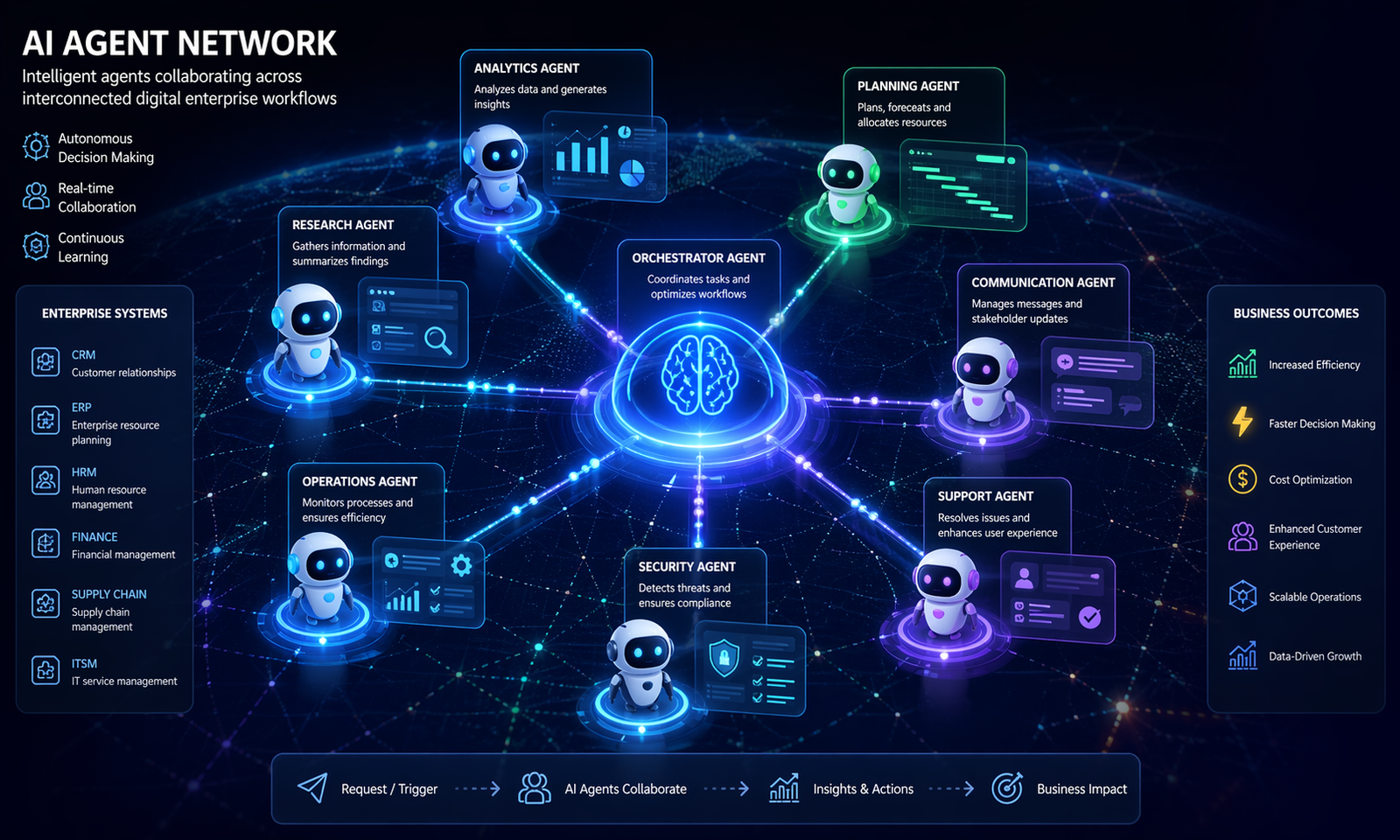
This "connected intelligence" also changes the role of the PMO. Instead of spending 60% of their time on status updates and data gathering, PMOs in the AI era act as "strategic orchestrators." They focus on aligning the AI's predictive outputs with the company's long-term vision. This culture of ownership empowers individuals at all levels to make informed decisions that contribute directly to the organization’s overall success, creating a flat, responsive structure that thrives on change rather than fearing it.
What are the barriers to scaling AI-driven agility?
Scaling AI-driven agility requires more than just capital; it requires a radical shift in organizational culture and data hygiene. While 88% of organizations have begun their AI journey, a significant number struggle at the scale-up phase because their internal data is fragmented across legacy systems.
The primary barriers identified by PMOs in 2026 include:
Data Governance: AI is only as good as the data it feeds on. Companies with "dirty data" or siloed information find that their AI agents provide inaccurate predictions, which erodes trust in the system.
Cultural Resistance: Middle management often fears that AI-driven decentralization will make their roles redundant. Overcoming this requires clear communication that AI is an "augmentation" tool, not a replacement for human judgment.
Technical Debt: Legacy infrastructure often cannot support the real-time API integrations required for agentic AI.
To overcome these, organizations must prioritize a "data-first" agile strategy. This involves consolidating data streams into a single source of truth before deploying complex AI workloads. Furthermore, an incremental approach—starting with a single department like HR or Finance—allows the business to prove value and build internal trust before rolling out AI-driven agility across the entire enterprise.


No comments yet. Be the first to share your thoughts!