


The surest way to miss the fantasy football playoffs in 2026 is to draft for "safety" at the quarterback position. While the instinct to secure a superstar like Josh Allen or Lamar Jackson early feels like a foundation for success, data suggests that the opportunity cost of an early-round quarterback often cripples the rest of your roster.
In a typical 12-team, 1-QB league, the difference in weekly output between the QB3 and the QB10 is rarely enough to offset the loss of an elite wide receiver or bell-cow running back. By waiting until Round 8 or later to select your signal-caller, you capitalize on the position's greatest asset: extreme depth.
This is the core of the Late-Round Quarterback strategy. It is not about finding the best quarterback; it is about building the best 16-man roster.
Why Does Positional Scarcity Dictate Draft Value?
The quarterback position is the deepest in fantasy football because the NFL has shifted toward high-volume passing and dual-threat playmakers. While only 12 quarterbacks start in your league each week, the pool of viable high-upside starters extends well into the late teens.
Contrast this with the "onesie" scarcity of elite running backs. A 2026 value over replacement player (VORP) analysis highlights that the drop-off at wide receiver and running back is significantly more precipitous than at quarterback. If you miss out on a top-tier RB in the first two rounds, you are often left chasing "dead zone" backs who lack guaranteed volume.
What Makes the 2026 Season Perfect for Waiting?
The 2026 draft landscape is uniquely suited for the late-round approach due to massive coaching turnover and a surplus of sophomore breakouts. With 17 NFL offenses featuring new play-callers this season, the market has not yet accurately priced the upside of several mid-to-late round quarterbacks. When established systems change, drafters default to "known" names, leaving explosive options like Caleb Williams, Drake Maye, or Bo Nix available in the middle or late rounds.
This coaching volatility creates "information asymmetry." While the general public waits to see how a new system operates, sharp managers identify high-volume schemes early. For instance, the transition to more aggressive, pass-heavy scripts in several Midwestern and West Coast offenses has historically inflated QB production beyond initial draft projections. By targeting these environments late, you are essentially buying a lottery ticket where the odds are tilted in your favor due to the surrounding infrastructure. These "system QBs" don't need elite talent to produce elite fantasy numbers; they simply need a coach who calls 40 pass attempts per game.
How do you execute the Late-Round QB strategy?
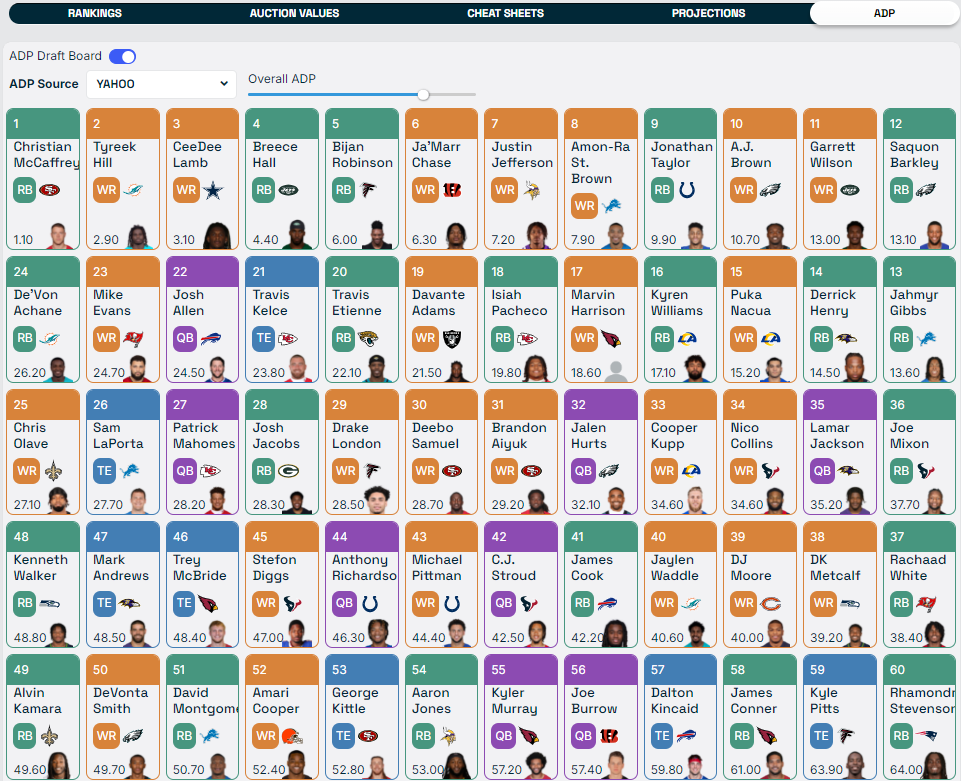
To execute this strategy successfully, you must remain disciplined during the Round 4 and 5 "QB feeding frenzy." When your league-mates begin panicking as Jalen Hurts and Patrick Mahomes leave the board, you should be hammering the Flex positions.
Rounds 1–3: The Anchor Phase
Your goal here is to secure high-floor, high-ceiling anchors. Target elite WR1s like CeeDee Lamb or Puka Nacua, or foundational RBs like Bijan Robinson and Jahmyr Gibbs. These players are the ADP leaders for a reason: their volume is nearly impossible to replace on the waiver wire.
Rounds 4–7: Positional Dominance
Instead of reaching for a quarterback, use these rounds to lock up your WR2, RB2, and High-Upside Flex. This is the range where you draft breakout sophomores or veterans in new high-volume systems, such as Rashee Rice or Mike Evans. By the time you reach Round 8, your skill-position starters should be superior to every other team in the league.
Round 8 and Beyond: The QB Strike
Now, you look for value. In the 2026 market, undervalued targets like Brock Purdy or rushing threats like Jaxson Dart often slip past their projected value. You are looking for a quarterback who can finish as a Top-10 performer but is priced at his floor.
Which Quarterback Archetypes Should You Target Late?
Not every late-round quarterback is created equal. To mirror the production of early-round stars, you must target specific profiles that offer massive upside.
The Dual-Threat Sophomore: Players who have a year of NFL seasoning and world-class athleticism. Their legs provide a scoring floor that pure pocket passers can't match.
The Infrastructure Beneficiary: Quarterbacks playing behind top-ranked offensive lines like the Lions, Colts, or Eagles. Protection leads to efficiency and deep-ball opportunities.
The Coaching Mismatch: Targeted players in systems run by offensive masterminds like Klint Kubiak or Mike LaFleur, where scheme-driven production outpaces pure talent.
Quarterback Target | 2026 ADP Range | Primary Upside Driver |
|---|---|---|
Caleb Williams | Round 6–7 | Elite weapons and Year 2 leap in high-volume system. |
Drake Maye | Round 7–8 | Significant rushing floor combined with a strong arm. |
Jaxson Dart | Round 9+ | High-tempo offense with favorable scheme metrics. |
Brock Purdy | Round 10+ | Extreme efficiency and continuity in established system. |
How to Handle a Quarterback "Bust"
One of the biggest advantages of the late-round strategy is that you aren't "married" to your pick. If you draft a Round 3 quarterback and he underperforms, you are forced to start him because of the draft capital invested.
If your Round 10 quarterback struggles, you can cut him without hesitation and stream the position. Streaming involves playing the waiver wire based on weekly matchups—targeting weak secondaries or high-total games. In any given week, a waiver-wire QB in a "smash spot" can easily outscore a superstar in a difficult road matchup.
Why Do Most Managers Fail to Wait?
Most fantasy managers lose their drafts because of a psychological phenomenon known as "risk aversion." The fear of starting a "boring" quarterback leads them to overpay for names they recognize from highlight reels. They value the security of a superstar over the mathematical advantage of a deeper bench. In reality, the "safe" pick is the one that allows your roster to absorb an injury to a starting running back without ruining your season.
Professional high-stakes players often refer to this as building a "robust" roster. By the time you reach the middle rounds, the draft isn't about finding players you like; it is about exploiting the inefficiencies of your opponents. If four managers in your league have already drafted a quarterback by Round 5, those managers have significantly weakened their ability to compete at the Flex positions. You win by being the manager who stays disciplined while others chase the shiny object.
This discipline pays dividends in the final weeks of the season. Statistics from the last five seasons of high-stakes play indicate that teams with deeper skill-position benches have a 14% higher "late-season survival rate" compared to teams that drafted a QB in the first three rounds. When bye weeks and soft-tissue injuries strike in November, the late-round drafter is often the only one still starting viable WR2s in their Flex spots.
The Myth of the "Elite" Advantage
A common counter-argument is that elite quarterbacks provide a "weekly ceiling" that late-round picks can't touch. While a 40-point game from an elite QB is spectacular, it is also rare. On a points-per-game basis, the gap between the QB1 and the QB12 is typically around 5-7 points. Meanwhile, the gap between an RB1 and a waiver-wire replacement can exceed 12-15 points per week.
When you draft for quarterback "safety," you are essentially trading a massive advantage at a high-scarcity position for a marginal gain at a low-scarcity one. It is a losing mathematical trade. The Late-Round QB strategy forces you to get comfortable with "good enough" at quarterback so you can be "unbeatable" at running back and wide receiver. This trade-off is the single most important factor in making the playoffs year after year. Every point counts, but points from a RB2 are significantly harder to acquire once the draft is over than points from a QB10. Use your draft capital where it can't be replaced.
Does This Strategy Win Every League?
No strategy is infallible, but JJ Zachariason’s research has repeatedly shown that the late-round quarterback philosophy maximizes your "win probability" by making your roster more resilient to injuries.
When your RB1 goes down in Week 4, the late-round QB drafter has a deep bench of RB2s and WR3s to plug the gap. The manager who drafted an elite QB early often has a "stars and scrubs" roster with no viable replacements. In fantasy football, surviving the war of attrition is just as important as having the highest-scoring player.
Summary Checklist for Draft Day
Avoid the Elite QB trap: Do not draft a QB in the first five rounds unless the value is truly historic.
Prioritize Rushing Upside: If you wait, look for QBs who can give you 40+ yards on the ground per game.
Monitor Offensive Lines: A quarterback is only as good as his protection.
Embrace Disruption: Target QBs in new, aggressive offensive schemes that the market hasn't caught onto yet.
By the time the playoffs roll around in December, your league-mates will be scrambling for waiver-wire wide receivers. You, however, will be riding a deep, balanced roster led by a quarterback you "stole" in the double-digit rounds. That is how you win championships!

Discussion