
Thinking Outside the Box: Your 2026 Career Edge
Thinking outside the box means finding fresh solutions by looking past the usual "standard" ways of doing things. In 2026, as machines handle more routine tasks, this ability to stay flexible and creative has become your most valuable career asset. By breaking away from old patterns, you can spot chances and solve problems that others—and even AI—might miss.
Why standard solutions are no longer enough
As automation accelerates, the "safe" middle ground is disappearing. Relying on established protocols is efficient for machines, but human value now lies in the ability to pivot when those protocols fail. Cultivating a mindset that looks beyond the obvious isn't just a creative choice anymore; it's a professional necessity for anyone looking to lead in the modern economy.
Why Does Creative Thinking Matter in 2026?
Non-linear thinking is your best way to stay indispensable at work and keep your career moving forward. As of July 2026, the World Economic Forum’s Future of Jobs Report shows that while tech is changing many roles, 170 million new ones are appearing—and almost all of them need "human" skills like adaptability and empathy.
The shift is happening because robots are great at following rules, but they struggle with "gray areas." A 2026 Harvard Business Review study found that AI tools only truly help people who know how to steer the machine toward original ideas rather than just accepting the first "autopilot" answer it gives.
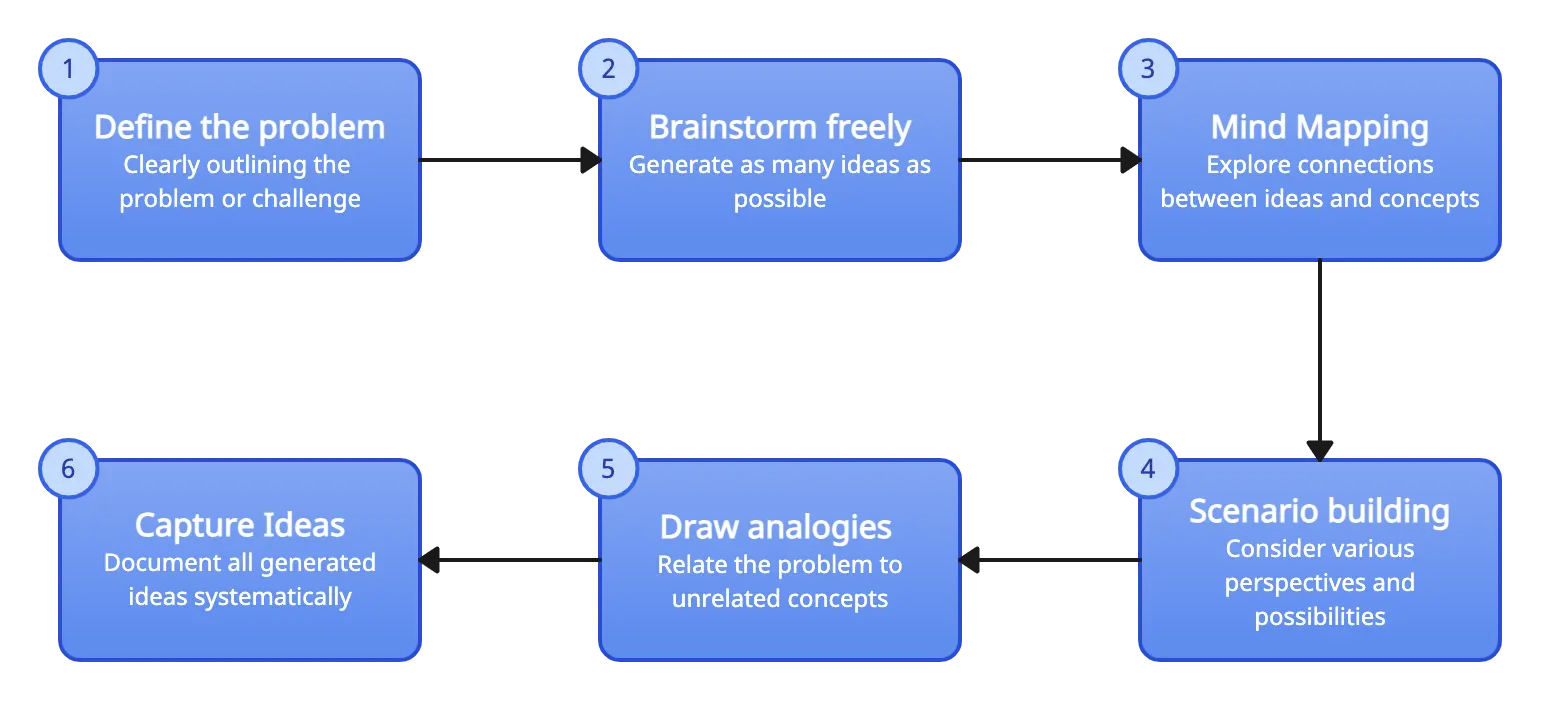
What Is the Difference Between Convergent and Divergent Thinking?
Convergent thinking is finding the one "right" answer, while divergent thinking is about brainstorming many possibilities. Most of us were taught in school to find the single correct box to check, which is great for efficiency but tough for innovation.
Truly thinking outside the box starts with a divergent approach. It means you stop judging ideas immediately and start connecting dots that don't seem to belong together. Breakthroughs don't happen when you're following a checklist; they happen when you temporarily put the rules aside to see what else might work.
How Can You Master Lateral Thinking Techniques?
Lateral thinking is just a fancy name for approaching a problem from the side instead of head-on. In 2026, top teams use specific tricks to prevent "groupthink," which is when everyone just agrees with the first idea mentioned to avoid conflict.
Here are a few ways to push your brain to see new paths:
The Flip-It Method (Reverse Brainstorming): Instead of asking how to win, ask how to fail. By listing every way a project could go wrong, you'll suddenly see the smart moves you need to make to succeed.
The SCAMPER Checklist: This is a simple tool to twist an old idea into something new by asking: Can I substitute a part? Can I combine it with something else? Can I eliminate a step?
"How Might We" Brackets: Reframing a problem as a question for exploration keeps your mind open. Instead of saying "We can't afford this," ask "How might we do this with zero budget?"
The Role of Metacognition in Creative Problem Solving
Metacognition is basically being the boss of your own brain. It's the ability to notice when you’re stuck in a "rut" of old thinking and intentionally pulling yourself out of it.
According to recent behavioral research, the most creative pros in 2026 use AI as a "sparring partner" to challenge their gut feelings. They don't just ask AI for the solution; they ask it to find the flaws in their plan or to suggest three "wildcard" ideas that most people would ignore.
How to Build a Culture of "Out-of-the-Box" Thinking?
To foster innovation, a team must feel "psychologically safe" to propose ideas that might sound ridiculous at first. If the first reaction to an unconventional thought is criticism, the "box" immediately reinforces itself.
Effective group brainstorming in 2026 balances free-thinking with structured guidance. Many teams now use "brainwriting"—where participants write ideas silently for 10 minutes before sharing—to ensure that loud voices don't drown out more nuanced, lateral ideas. This structure prevents the team from converging too quickly and allows the quietest, most unconventional thoughts to reach the table.
The Neuroscience of Creative "Flow" and Insight
The biology behind creative thinking isn't magic; it’s about how different parts of your brain talk to each other. Usually, your brain has two main modes: one for focused work and one for daydreaming. Thinking outside the box happens when these two modes stop fighting and start working together.
In neuroscientific studies from 2025 and 2026, researchers found that creative people have stronger "shortcuts" between these brain areas. This helps them scan through memories and random facts while still staying focused on the problem at hand. It’s like having a well-organized library where you can find exactly what you need, even if it’s tucked away in a corner you haven't visited in years.
Mental Models for Breaking Through Cognitive Bias
Our brains love to take shortcuts, which often keeps us stuck in the same old routines. To break out, you need to intentionally trip up your natural habits and force your mind to take a new path.
Simple Strategy | How it breaks your routine | Real-World Example |
|---|---|---|
First Principles | Strip a problem down to the basics instead of doing what's always been done. | Rethinking how a product is made by looking at the cost of raw materials, not the current price. |
Inversion | Focus on what could go wrong so you can find better ways to make things go right. | Improving customer service by first listing every way you could possibly annoy a customer. |
Random Connections | Force yourself to connect your problem to a completely random word. | Using the word "bicycle" to brainstorm new ways to move data through a computer network. |
Case Study: The "Outside the Box" Pivot in Modern Infrastructure
A great example of this in action happened in late 2025 with a big delivery hub that was stuck with constant delays. The "standard" answer was to build a new $400 million warehouse—a huge expense that would take years to finish.
Instead, the team looked at what they already had. They realized that city buses and trash trucks are often parked during the middle of the day. By using these idle vehicles as temporary sorting spots, they cut down delays by 42% without spending a dime on new buildings. They succeeded because they stopped seeing a bus as "just a bus" and started seeing it as a tool they could use in a new way.
Overcoming the "Fear of the Box"
The biggest thing stopping us from sharing wild ideas isn't a lack of imagination—it's the fear of looking silly in front of our boss or coworkers. We stick to the "box" because it feels safe, even when it’s not working anymore.
Leaders in 2026 are fixing this by holding "pre-mortems" where they talk about why a creative idea wasn't tried. They want to show that playing it too safe is actually riskier than taking a calculated chance. You can practice this yourself by asking: "If we had no money at all, how would we solve this?" These kinds of questions force your brain to stop looking for the "safe" middle ground and start finding the breakthrough paths.
The Synergy Between Human Intrinsics and AI Utility
The future of solving problems isn't about humans vs. machines—it’s about using technology to boost your own natural skills. While AI can throw a thousand ideas at you, it still needs a human to decide which ones actually matter.
Thinking outside the box today means knowing when to look at the data and when to trust your gut. As a Mortgage Loan Originator with eight years of experience, I’ve seen this myself: computers are great at checking numbers, but they often miss the "story" behind a person that a human can see. That human touch is exactly what lives "outside the box" of a standard computer program.
Frequently Asked Questions
Can anyone learn to think outside the box?
Yes. Creative thinking is a cognitive muscle, not a fixed trait. By practicing lateral thinking techniques like SCAMPER or reverse brainstorming, individuals can deprogram their reliance on linear logic and develop the habit of looking for alternative paths.
Is thinking outside the box risky for a business?
While unconventional ideas carry higher uncertainty, the risk of "thinking inside the box"—stagnation and irrelevance—is often greater in a rapidly changing market. Organizations mitigate this risk by using divergent thinking for idea generation and convergent thinking for rigorous testing and implementation.
Do I need AI to be creative in 2026?
AI is a powerful tool for expanding the "search space" of ideas, but it lacks human intuition and context. The most successful innovators use AI to generate volume, then apply their own metacognitive skills to select and refine the most novel concepts.
Three-Minute Exercise: The "Impossible Object" Challenge
Want to flex your creative muscles right now? Grab a pen and use the Flip-It Method on this everyday object: An umbrella.
Instead of thinking about how an umbrella keeps you dry, ask the opposite: "How could I use an umbrella to get something wet?"
Flip It: Maybe it becomes a portable birdbath? A funnel for a garden barrel? Or a giant upside-down sprinkler for kids to run through?
SCAMPER It: Can you Substitute the fabric with a mesh net to catch butterflies? Can you Combine it with a walking stick for extra stability?
Take 60 seconds to jot down three ideas that seem totally "wrong." You’ll find that once you give your brain permission to stop being practical, the breakthrough ideas start to show up.
Pro Tip: Try this with your hardest work problem tomorrow morning. Instead of asking "How do we fix this?", ask "How could we make this problem 10 times worse?" The answers will point you directly toward the solutions you’ve been missing.
Start thinking beyond the box today
The most successful professionals of 2026 aren't just experts in their field—they are experts at seeing what others miss. By intentionally practicing these lateral thinking habits and leveraging AI as a creative partner, you can ensure your skills remain both relevant and irreplaceable.
Don't wait for a crisis to innovate; start challenging one standard "rule" in your workflow tomorrow and see where the new path leads.
About the Author
Dixie Lowe is a Mortgage Loan Originator at Integrity Home Mortgage in Roanoke, VA. With eight years of experience, Dixie combines deep industry knowledge with a commitment to finding creative, personalized solutions for her clients. She believes that while technology can simplify the mortgage process, the true "outside the box" value comes from the human connection and empathy that only an experienced professional can provide.


No comments yet. Be the first to share your thoughts!